
Concrete Contractor Lawrenceville GA: What to Look For
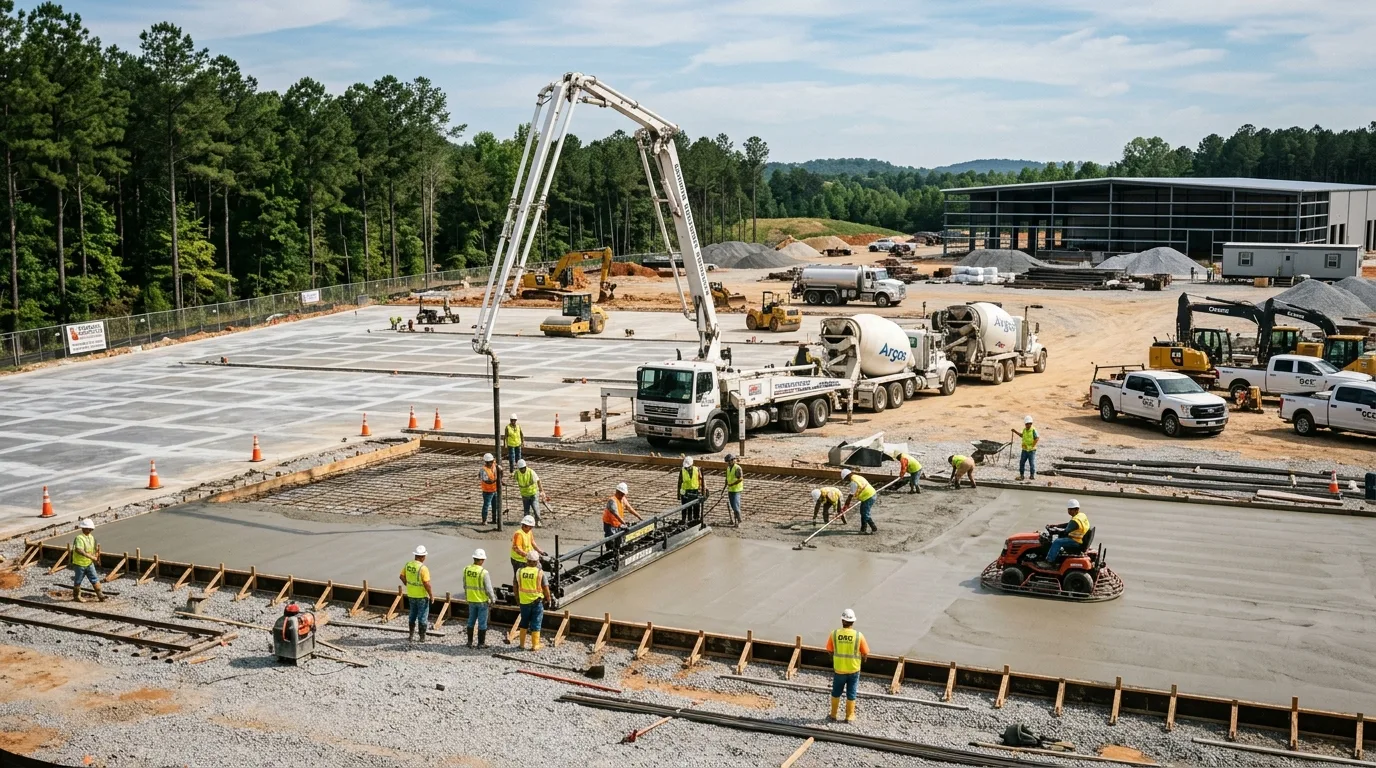
Choosing the wrong concrete contractor in Lawrenceville is an expensive mistake — not just because you’ll pay for a bad pour, but because bad concrete on Gwinnett County’s expansive red clay can fail within a few seasons and require costly removal and replacement. The good news: a few specific questions separate contractors who understand this market from those who don’t. This guide gives you the exact criteria to use when hiring a concrete contractor in Lawrenceville, GA in 2026.
In this post, we cover: what credentials to verify, what questions to ask about local soil and climate experience, red flags that signal trouble, and what a high-quality written estimate looks like for Lawrenceville concrete work.
Planning Concrete Work in Lawrenceville?
Tell us about your project and we'll connect you with an independent concrete contractor serving Lawrenceville and Gwinnett County. Call (770) 637-7481.
Why Contractor Selection Matters More in Lawrenceville
Concrete installation in Lawrenceville is not the same as concrete installation in a city with sandy or loam soils. Gwinnett County’s red clay is an expansive material that moves with moisture — swelling in wet periods and contracting during the summer drought season. A concrete driveway or patio installed without adequate base preparation for this soil behavior will crack along predictable stress lines within 3–7 years, regardless of the concrete quality itself.
The specific demands of Lawrenceville’s clay subgrade mean that local experience — not just general concrete experience — is what you’re actually evaluating when you interview contractors. A crew that has been working in Gwinnett County for years understands the base depth required, the compaction spec needed, and the reinforcement approach that accounts for seasonal movement. A crew from outside the Atlanta metro working in the area for the first time may not.
Credentials to Verify Before Signing Anything
General liability insurance: A minimum of $500,000 general liability coverage. Ask for the certificate of insurance — a legitimate contractor provides it immediately without hesitation. Verify the policy is current and that the coverage amount is listed on the certificate.
Workers’ compensation coverage: Protects you if a laborer is injured on your property. Georgia law requires workers’ compensation for employers with three or more employees. Ask specifically whether the crew doing your work is employees or subcontractors — subcontractors may not be covered under the prime contractor’s policy.
State and local business registration: Georgia doesn’t issue concrete-specific contractor licenses at the state level, but contractors should be registered as a legal business entity. Search the Georgia Secretary of State’s business registry to confirm the company exists.
Gwinnett County permit knowledge: Ask whether they’ve pulled permits in Gwinnett County for work that required one (foundations, larger concrete structures). A contractor familiar with Gwinnett County’s Zoning, Inspections, and Permitting (ZIP) Portal process has done formal work in this jurisdiction. For most driveways, permits aren’t required — but a contractor who doesn’t know the permit rules isn’t paying close attention to local regulations.
Questions That Reveal Local Concrete Experience
“How deep do you excavate and what base spec do you use for clay soil in Gwinnett County?” The right answer: they excavate to at least 6–8 inches below finish grade, install 4+ inches of compacted gravel, and compact to approximately 95% proctor density. A vague answer about “putting down some gravel” is a red flag.
“What concrete mix do you specify for outdoor flatwork in Lawrenceville?” The right answer includes air-entrainment (for freeze-thaw protection) and a minimum 3,500–4,000 PSI strength specification. A contractor who doesn’t know what air-entrained concrete is or why it matters in Georgia hasn’t thought about winter concrete failure modes.
“How do you handle curing in Georgia’s summer heat?” The right answer: wet curing blankets, curing compound, or early morning pours — any approach that prevents rapid moisture loss from summer heat. A contractor who says “we just let it dry” doesn’t understand concrete curing.
“Can I see photos of Lawrenceville or Gwinnett County projects that are at least 3 years old?” Older photos reveal whether their work holds up — look at corners and edges for lifting or separation from soil movement.
Practical Uses: Matching the Right Contractor to Your Project Type
New concrete driveway installation: Prioritize contractors with documented experience on Gwinnett County’s clay soil. Ask specifically about base compaction methods and rebar vs mesh reinforcement decisions. See our guide on concrete driveway installation in Lawrenceville.
Stamped concrete patio: Stamped concrete is a specialist skill — not every general concrete contractor has the crew experience and tool inventory for clean stamped work. Ask to see at least 5 stamped concrete photos and verify they’ve completed projects with the pattern complexity you want.
Foundation pour for addition or outbuilding: This work requires a Gwinnett County permit and a pre-pour inspection. Only use contractors who have navigated this process before and can show you the permit they pulled on a past project.
Concrete repair: The right contractor diagnoses the cause before quoting a repair method. See our concrete repair in Lawrenceville service page for what the assessment process should look like.
Service area work in Duluth or Snellville: Contractors serving the broader Gwinnett County area should have comparable knowledge of permit rules and soil conditions across neighboring communities.
Commercial concrete: Larger commercial pours (parking lots, loading docks) require different insurance minimums and potentially different licensing — verify accordingly.
Red Flags That Signal Trouble
No written estimate: Any legitimate contractor provides a written scope and price before starting work. Verbal-only pricing creates disputes.
Request for large upfront payment: A 10–20% deposit is standard for materials. Requests for 50%+ upfront before work starts signal financial instability.
Door-to-door solicitation with “leftover concrete”: A known scam in Georgia — no legitimate company operates this way.
Prices 40%+ below other estimates: Quality concrete work has material and labor costs that can’t be compressed that much. Low outlier bids either hide costs that appear as change orders or represent inferior base preparation.
Unwillingness to provide insurance certificates: Legitimate contractors provide these immediately. Any delay or resistance is a disqualifier.
No local references: A contractor who can’t provide two or three references from Lawrenceville or Gwinnett County hasn’t done enough local work to understand your site conditions.
What a Good Estimate Looks Like
A high-quality written estimate for concrete work in Lawrenceville includes line items for: demolition and haul-off (if applicable), excavation to specified depth, gravel base (with depth and compaction specification), concrete (with PSI strength, mix design, and reinforcement type), finish type, control joint placement, sealer, and timeline. It should specify the number of square feet covered and the concrete thickness.
If an estimate bundles everything into a single “installed price” number, ask the contractor to break it out. If they refuse, walk away — they’re hiding something.
Questions to Ask Before You Hire
Tell us about your project and we'll connect you with an independent concrete contractor serving Lawrenceville and Gwinnett County. Call (770) 637-7481.
Frequently Asked Questions
How do I verify a concrete contractor is legitimate in Lawrenceville GA?
Start with the Georgia Secretary of State business search to confirm the company is registered. Request the certificate of general liability insurance and verify it’s current. Ask for two or three references from Lawrenceville or Gwinnett County projects completed in the last 12 months. Call the references and ask specifically whether the contractor showed up on schedule, stayed on budget, and cleaned up completely after the job.
What should a concrete driveway contract include?
A proper contract for a Lawrenceville concrete driveway includes: total square footage, concrete thickness, gravel base specification, reinforcement type, finish type, control joint spacing, timeline with start and completion dates, payment schedule, warranty terms, and permit responsibilities. Never start concrete work on a verbal agreement. To see how requests work, visit the about page.
How do I compare multiple concrete estimates in Lawrenceville?
Compare apples to apples: verify each estimate specifies the same concrete thickness, base depth, reinforcement type, and finish. A low estimate that uses 4 inches of concrete versus a competitor’s 5-inch spec is not a fair comparison. Ask each contractor to confirm what they’re including in the base prep spec — that’s where most of the variation in quality (and long-term performance) lives.
Get a Transparent Estimate in Lawrenceville
Tell us about your project and we'll connect you with an independent concrete contractor serving Lawrenceville and Gwinnett County. Call (770) 637-7481.
Related: