
Concrete Walkway Installation in Lawrenceville GA: 2026 Guide
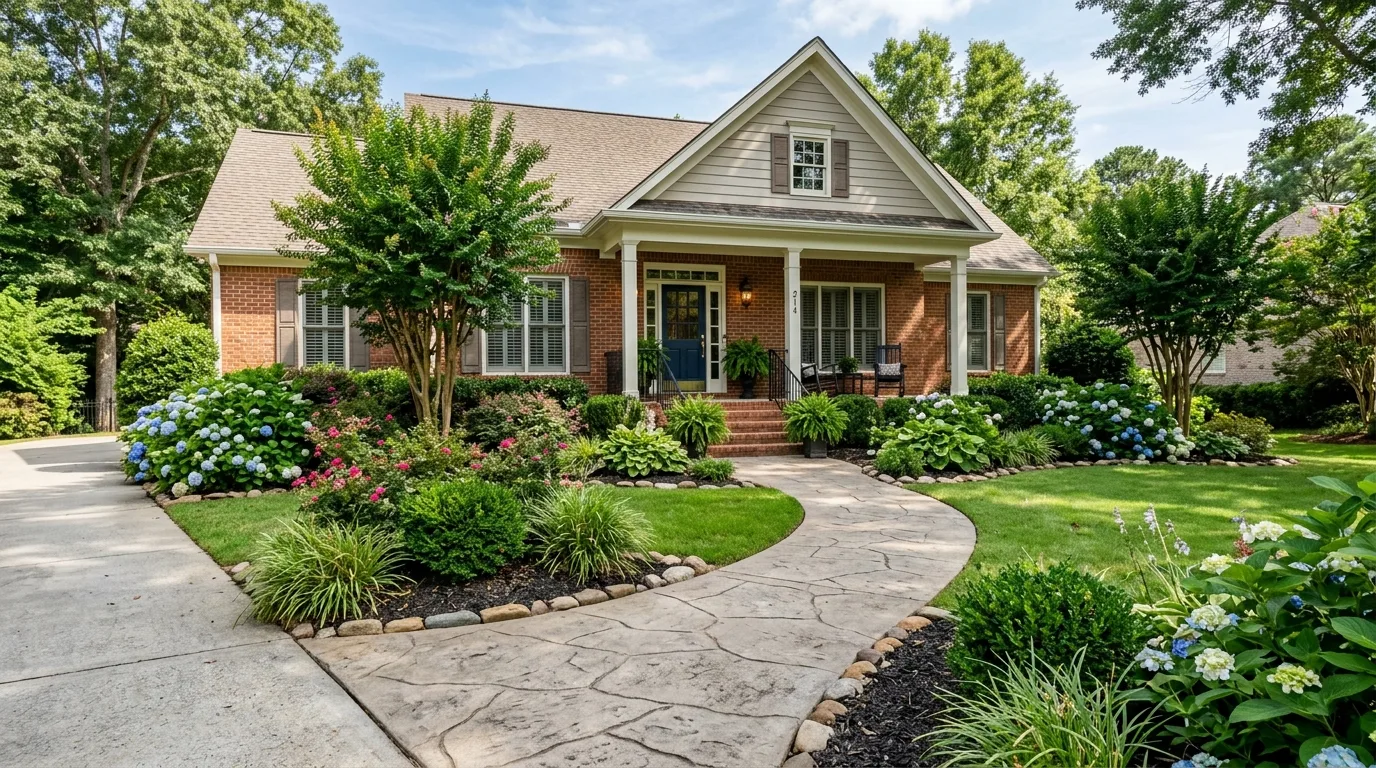
Concrete walkways in Lawrenceville serve a practical function and a curb appeal function simultaneously — and a well-installed one handles both for 30+ years with minimal maintenance. The key word is “well-installed”: walkways in Lawrenceville that fail within 5–10 years share a consistent cause — inadequate base preparation for Gwinnett County’s expansive clay soil. This guide explains what concrete walkway installation involves in Lawrenceville, what it costs, how the process works, and what distinguishes a properly installed walkway from one that will need repair or replacement in a few years.
Free Concrete Walkway Estimate in Lawrenceville
We assess your property and provide written, itemized pricing before any work begins. Call (888) 376-0955.
Concrete Walkway Costs in Lawrenceville GA
Concrete walkway installation in Lawrenceville runs $6–$14 per square foot, depending on width, length, finish type, and site conditions. Here’s how typical walkway projects break down:
Small entry path (40–60 sq ft): $240–$840 Mid-size front walkway (80–120 sq ft): $480–$1,680 Full entry path with steps (100–150 sq ft): $800–$2,100 (steps add cost — typically $150–$300 per step depending on width) Extended rear or side walkway (200–300 sq ft): $1,200–$4,200
These ranges reflect the full scope of a properly installed walkway: excavation, aggregate base, concrete, finishing, control joints, and sealing. Lower estimates that skip base preparation are not comparable — they’re a different (inferior) product.
Finish Options for Lawrenceville Walkways
Broom finish: The standard — parallel or perpendicular brush marks in the concrete surface that provide traction and complement virtually any home style. Works in full sun or shade and holds up well in Gwinnett County’s climate. The least expensive finish option at $6–$9 per square foot.
Exposed aggregate: Surface cement paste is washed off before curing to reveal the stone aggregate beneath. More decorative than broom finish, with excellent natural traction. Popular in Lawrenceville neighborhoods where the walkway connects to natural stone landscaping. $8–$12 per square foot.
Stamped concrete walkway: Patterns pressed into the concrete replicate stone, brick, or pavers. Particularly effective for front entry walkways where visual impact matters. Requires resealing every 2–3 years to maintain color in Georgia’s UV-intense climate. $10–$14 per square foot.
Brushed with stamped border: Plain broom field with a decorative stamped border along the edges — a cost-effective way to add visual interest without full stamped pricing. $8–$12 per square foot.
What the Installation Process Looks Like
Week before: Confirm the scope, walkway width, finish type, and any steps or transitions. Mark utilities with 811 before excavation begins.
Day 1 — Excavation and base work: The crew excavates the walkway path to 6–8 inches below finish grade and removes soil. Aggregate base (typically 4 inches of compacted #57 stone) is installed and mechanically compacted. Forms are set at the correct grade and slope — walkways should slope 1/8 to 1/4 inch per foot away from the house for drainage.
Day 2 — Pour and finish: Concrete is poured into the forms, screeded to grade, floated, and finished with the selected surface texture. Control joints are tooled or cut at regular intervals (every 4–5 feet for a 4-foot-wide walkway). Sealer or curing compound is applied.
Curing: The walkway is ready for light foot traffic in 24–48 hours. Avoid heavy loads for 7 days. Full 28-day cure before applying decorative sealers.
Typical timeline: Most residential walkway installations complete in 1–2 days. Site prep and base work on day one; pour and finish on day two.
Base Preparation Requirements for Lawrenceville’s Clay Soil
The failure mode for concrete walkways in Gwinnett County is identical to the failure mode for driveways: clay soil swells and contracts with seasonal moisture changes, transmitting mechanical stress into the slab from below. Walkways are narrower than driveways and less frequently trafficked, but the soil movement doesn’t care about those distinctions — an improperly prepared walkway on Lawrenceville’s clay will crack and heave on the same timeline as a poorly prepared driveway.
The correct base for a walkway on Gwinnett County’s clay:
- Excavate to 6–8 inches below finish grade
- Install 4 inches of compacted angular aggregate (#57 stone or equivalent)
- Compact to approximately 95% proctor density using a plate compactor (not hand tamping)
- Grade the base for drainage slope matching the finished surface
A walkway spec that calls for 3–4 inches total depth (base plus concrete) is not adequate for Lawrenceville’s clay subgrade. It may hold up for a few years — long enough that a contractor has moved on — but it won’t achieve the 30-year service life that a properly installed walkway should deliver.
Concrete Walkway Installation in Lawrenceville — Done Right
Proper base prep for Gwinnett County's clay, every project. Written estimate with every line item. Call (888) 376-0955.
Walkway Design Considerations for Lawrenceville Homes
Width: Standard residential walkways are 3–4 feet wide. ADA-accessible walkways should be 5 feet minimum. Narrower than 3 feet feels cramped; wider than 5 feet for a simple entry path begins to look like a patio.
Transitions and steps: Many Lawrenceville homes have grade changes between the driveway and the front entry. Concrete steps integrated with the walkway provide a clean, maintenance-free solution. Steps should be 12–14 inches deep (tread) and 5–6 inches high (riser) for comfortable use.
Drainage slope: Walkways must slope away from the house at 1/8–1/4 inch per foot. This seems subtle but is critical — Lawrenceville’s 50+ inches of annual rainfall will eventually find any low spot that holds water against the foundation.
Control joint spacing: For a standard 4-foot-wide walkway, control joints every 4–5 feet allow the concrete to crack in controlled locations rather than randomly. Control joints should be cut to at least 1/4 of the slab depth.
Tree proximity: Mature trees adjacent to proposed walkways require root evaluation before installation. Root barriers may be appropriate where root intrusion over time is a likely concern — specifically for large specimen trees within 10 feet of the walkway path. See our experience with this issue in neighborhoods like Flowers Crossing at the Mill, where mature tree coverage is a characteristic of many properties.
Concrete Walkway vs. Paver Walkway in Lawrenceville
Paver walkways are popular in Lawrenceville, and many homeowners ask whether pavers or concrete is the better choice for an entry path. The comparison in Gwinnett County’s specific conditions:
Pavers on clay: Individual pavers are flexible — each one can settle independently as the clay beneath moves seasonally. Over 5–10 years on Gwinnett County’s clay, paver walkways typically develop noticeable differential settlement (some pavers lower than adjacent ones), which creates trip hazards and drainage problems that require periodic releveling. Joint sand washes out in Lawrenceville’s heavy rain events, accelerating the settlement.
Concrete walkway on clay: A rigid slab distributes clay movement more evenly. With adequate base preparation, a concrete walkway doesn’t develop the individual paver settlement problem. It can crack if movement is severe, but properly placed control joints direct cracks to invisible locations and the slab remains level.
Cost: Paver installation runs $12–$25 per square foot for quality pavers — significantly more than standard concrete at $6–$12 per square foot. The cost premium for pavers in Lawrenceville delivers a material that requires more maintenance and tends to perform less consistently on the local clay soil.
For homeowners who want the look of pavers without the performance issues, stamped concrete in a brick or cobblestone pattern delivers comparable aesthetics at lower cost and better performance on Gwinnett County’s clay subgrade. See our full concrete walkway service page for Lawrenceville for service details and options.
Frequently Asked Questions
How long does concrete walkway installation take in Lawrenceville GA?
Most residential concrete walkway installations in Lawrenceville take 1–2 days. A simple, straight entry path (50–80 sq ft) with no steps can typically be completed in a single day — excavation, base work, pour, and finish. Larger walkways, those with integrated steps, or stamped concrete installations take 2 days. The concrete needs 24–48 hours before foot traffic and 7 days before heavy use.
Do I need a permit for a concrete walkway in Lawrenceville?
Typically not, for private walkways on your property. Gwinnett County’s permit threshold for residential hardscaping applies to front yard impervious coverage — walkways that keep total front yard coverage under 35% don’t require a permit. Any work in the public right-of-way (the strip between the sidewalk and the street) requires coordination with Gwinnett County regardless of size. See our full concrete permit guide for Lawrenceville for details.
What’s the best concrete finish for a walkway in Lawrenceville’s climate?
Broom finish is the most practical: it provides reliable traction in wet conditions (Lawrenceville averages 50+ inches of rain per year), holds up to UV exposure and Georgia’s temperature swings without special maintenance, and complements virtually any home style. Exposed aggregate is an excellent upgrade — better visual interest without the resealing requirement of stamped concrete. Stamped concrete is the premium option for homeowners who prioritize curb appeal and are comfortable with the 2–3 year resealing schedule. See our concrete walkway service page for example finishes.
Related: