
Gwinnett County Red Clay Soil and Concrete: What to Know
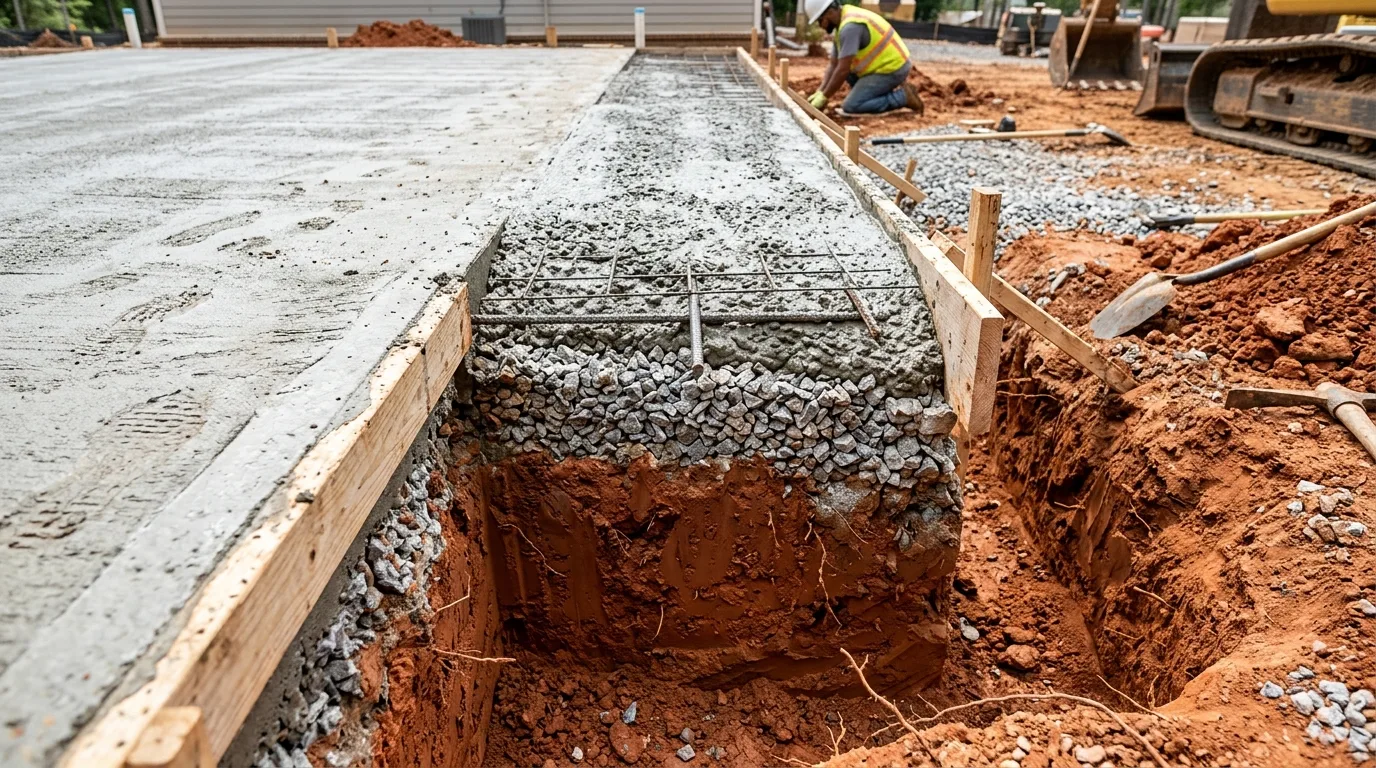
Gwinnett County’s red clay is the single biggest variable that separates good concrete installation from bad in the Lawrenceville area. Contractors who understand how this soil behaves design their base preparation accordingly. Those who don’t produce slabs that look fine on day one and develop problems on year three. If you’re planning any concrete work in Lawrenceville — a driveway, patio, walkway, or foundation — understanding what the clay under your property actually does will help you evaluate contractor proposals and make better decisions about your project.
This post explains: what Gwinnett County’s red clay is and how it formed, why expansive soil is harder on concrete than other soil types, what happens to concrete when base preparation doesn’t account for clay movement, and what the right installation approach looks like.
Concrete Built for Gwinnett County's Clay Soil
Every estimate we provide includes base specifications designed for local soil conditions. Call (888) 376-0955.
What Gwinnett County Red Clay Actually Is
The dominant soil across most of Gwinnett County is formed from the weathering of crystalline Piedmont rock — granite, gneiss, and schist — over millions of years. The decomposition of these parent materials produces a fine-grained, iron-rich clay soil with two properties that matter enormously for concrete work: high plasticity and significant shrink-swell behavior.
The iron oxide content (which gives the soil its red-orange color) is cosmetically distinctive but mechanically less significant than the clay mineral content. The dominant clay minerals in Gwinnett County soils — kaolinite and smectite — are what drive the expansive behavior. Kaolinite is relatively stable; smectite is highly expansive. Soils with a higher smectite fraction can change volume by 10–20% between their wettest and driest states.
This means that a cubic yard of Lawrenceville subgrade doesn’t stay the same size year-round. It swells when the water table rises during spring rain events and shrinks as the soil dries out during Georgia’s summer drought season. Any rigid structure sitting above it — a concrete slab, a foundation, a sidewalk — experiences this movement as mechanical force.
How Clay Movement Damages Concrete
The damage mechanism is straightforward: concrete is strong in compression but weak in tension. When expansive clay beneath a slab swells unevenly — one area wets up faster than another — it pushes up on different sections of the slab with different force. The slab, which is rigid, can’t conform to this differential movement. Instead, it flexes. When the tensile stress in the concrete exceeds its tensile strength (roughly one-tenth of its compressive strength), it cracks.
This process repeats in reverse when the clay dries: sections of the slab lose subgrade support as the clay pulls away from the underside of the concrete. A slab that was fully supported is now bridging a partial void. When a vehicle drives over the unsupported section, the slab deflects downward, creating tensile stress from below. Eventually, it cracks at the weakest point — typically a control joint, a corner, or a previous crack.
The seasonal repetition of wet-dry-wet-dry cycles accumulates structural damage over time. A crack that opened to 1/8 inch in year one may widen to 1/4 inch by year three and 1/2 inch by year five as each wet season opens it further and each dry season allows debris to pack in, preventing full closure.
Why Neighborhoods Like Edgewater and Knollwood Lakes See This Pattern
Many of Lawrenceville’s established neighborhoods — including Edgewater, Knollwood Lakes, and Stratford Square — were developed in the 1980s and 1990s when concrete installation specifications for Georgia’s clay soil were less stringent than they are today. Driveways from that era were commonly installed with 3–4 inch gravel base on minimally graded subgrade.
That base depth was insufficient for Gwinnett County’s clay. The clay movement transmitted through 3–4 inches of gravel is still enough to stress concrete slabs over repeated seasonal cycles. Homeowners in those neighborhoods who are now replacing 25–35 year old driveways are, in many cases, replacing slabs that failed not from concrete defects but from inadequate base preparation for the soil they were sitting on.
The failure pattern looks almost identical across these properties: edge cracking along the garage apron, corner lifting at the transition between the street and the first driveway panel, and interior cracks running diagonally from panel corners toward the center.
Replacing a Cracked Driveway in Lawrenceville?
We install with the base prep Gwinnett County's clay actually requires — not the minimum spec. Call (888) 376-0955 for a written estimate.
What Correct Base Preparation Looks Like on Clay Subgrade
The goal of base preparation is to isolate the concrete slab from direct contact with expansive clay and to provide a uniform, stable surface under the slab that won’t shift with seasonal moisture changes.
Excavation depth: On Gwinnett County’s clay, proper excavation for a residential driveway goes 8–10 inches below finish grade. This allows for 4–6 inches of compacted aggregate base under a 4-inch concrete slab. Minimum-spec approaches that excavate only 5–6 inches total leave insufficient aggregate depth for clay isolation.
Aggregate base: The base material should be angular crushed stone or compactible gravel — not rounded river rock, which doesn’t interlock, and not recycled concrete fines, which retain moisture. Georgia DOT #57 stone is a common aggregate specification for residential flatwork in Gwinnett County.
Compaction: The aggregate base must be mechanically compacted to 95% of standard proctor density. Uncompacted or hand-tamped base settles under vehicle loads and allows the aggregate layer to redistribute — partially defeating its purpose. Proper compaction requires a plate compactor or jumping jack for the full base depth, not just the top layer.
Drainage: On clay sites with poor natural drainage, French drains or perimeter trenches may be necessary to prevent water from pooling against the underside of the aggregate base during heavy rain events. Clay is nearly impermeable — water that enters the aggregate layer from the side or top has nowhere to go without a drainage solution.
Reinforcement: On expansive clay sites in Gwinnett County, rebar reinforcement (typically #4 rebar at 18-inch centers) is more effective than welded wire mesh because rebar adds tensile strength in both directions and holds cracked panels together if they do separate. Wire mesh often sits low in the pour and provides less effective structural reinforcement than rebar placed at mid-slab height.
What This Means for Your Concrete Project
When evaluating concrete contractor estimates in Lawrenceville, ask specifically about base preparation:
- How deep will you excavate?
- What aggregate are you using and what thickness?
- How are you compacting the base?
- Is drainage addressed in the site plan?
A contractor who provides a vague answer or dismisses the question is telling you something important. The base prep is where the longevity of a Lawrenceville concrete project is determined — not the surface finish or the concrete mix alone.
Our concrete driveway service page details what we include in every installation for Gwinnett County’s specific soil conditions. For concrete foundations, where the stakes are higher, see our concrete foundation in Lawrenceville service page.
Frequently Asked Questions
Does Gwinnett County’s clay soil require special concrete?
The clay soil primarily requires special base preparation, not special concrete. The concrete mix itself should include air-entrainment (for freeze-thaw protection in Georgia’s winters) and a minimum 3,500 PSI compressive strength specification — both standard for outdoor concrete in the Southeast. The non-standard element is the base: deeper excavation, thicker aggregate, and more careful compaction than a contractor working in a sandy or loam soil market might routinely provide.
Can I pour concrete directly over Gwinnett County red clay?
No — this is the most common installation mistake in the Lawrenceville market. Pouring concrete directly over clay without an aggregate base allows the clay’s seasonal moisture movement to act directly on the slab from below. Even with rebar reinforcement, a concrete slab poured on unmodified clay subgrade will develop structural cracks within 5–10 years in Gwinnett County’s wet-dry climate cycle. The aggregate base layer is what buffers the clay movement from the concrete.
How much does proper base prep add to concrete driveway cost in Lawrenceville?
Adequate base preparation for Gwinnett County’s clay soil adds approximately $1–$2 per square foot over the absolute minimum spec. For a 700 sq ft driveway, that’s $700–$1,400 of additional base work. Contractors who price below the market rate are often skipping this step. The cost difference between minimum-spec base and clay-appropriate base is substantially less than one round of driveway replacement — making proper base prep the most economical choice by a wide margin over a 20-year horizon. See our concrete repair in Lawrenceville service page for what happens when base prep is skipped.
Related: