
Lawrenceville Neighborhoods and Concrete Driveways: A Local Guide
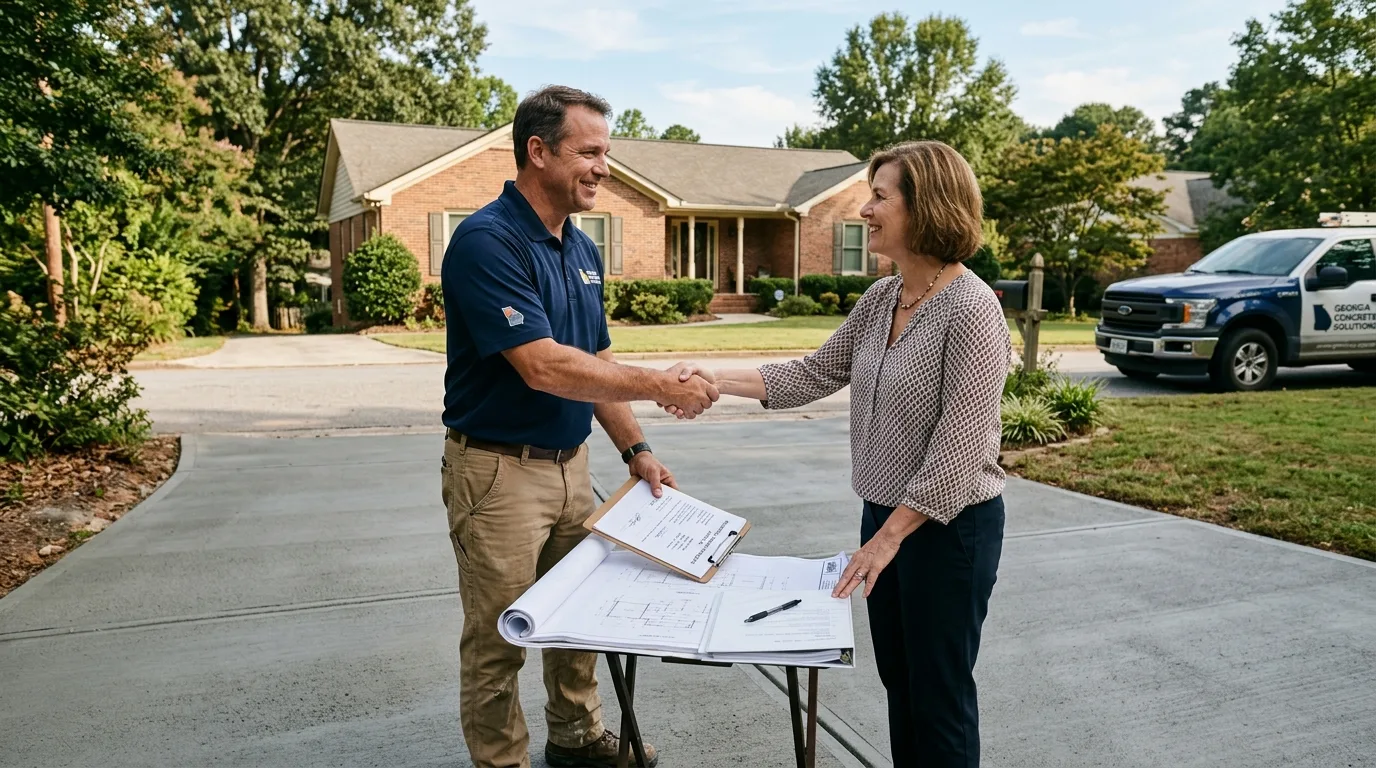
Lawrenceville’s residential neighborhoods aren’t uniform — they vary in age, housing style, HOA requirements, and the specific concrete challenges that come with when and how they were developed. A homeowner in Edgewater asking about driveway replacement is dealing with a different set of variables than a homeowner in Flowers Crossing at the Mill or a newer development near Dacula. This guide covers what Lawrenceville’s established neighborhoods and surrounding Gwinnett County communities typically see in terms of concrete driveway projects — the common patterns, the HOA considerations, and what the local installation requirements look like in each area.
Concrete Driveway Estimates for Any Lawrenceville Neighborhood
We know the local HOA requirements, soil conditions, and permit rules for every part of Gwinnett County. Call (888) 376-0955.
Edgewater
Edgewater is one of Lawrenceville’s most active neighborhoods for concrete driveway replacement, and for predictable reasons: the community was developed in the late 1980s and 1990s, placing many driveways in the 25–35 year age range where replacement makes more economic sense than continued repair.
Driveways in Edgewater show the pattern typical of Lawrenceville’s older concrete installations: edge cracking along the street-to-apron transition, diagonal cracking from the corners of garage apron panels, and surface scaling in shaded areas where moisture accumulates during Georgia’s wet spring season. These are the signature failure modes of driveways installed with 3–4 inch gravel base depth on Gwinnett County’s expansive red clay — the base spec that was common before deeper excavation became the standard for local clay soil.
HOA considerations in Edgewater: The neighborhood has an active HOA that reviews exterior modifications including driveway replacement. Standard concrete replacement in kind (same width, similar finish) typically doesn’t require ARB approval, but widening a driveway, adding a stamped or decorative finish, or changing the footprint may. Confirm with the HOA before finalizing any scope that changes the driveway appearance.
Typical project: Two-car driveway replacement with broom finish, $3,600–$7,200 based on current concrete driveway pricing for Lawrenceville.
Flowers Crossing at the Mill
Flowers Crossing at the Mill’s residential lots border the natural areas around Tribble Mill Regional Park — one of the most distinctive characteristics of this community and a factor that affects concrete driveway projects in specific ways. Properties adjacent to the natural buffer have tree coverage that creates two issues: root intrusion under existing driveways and shaded surfaces that accumulate biological growth faster than sun-exposed concrete.
The tree canopy in Flowers Crossing also means that driveway replacement projects frequently encounter root networks that have grown beneath the aggregate base over 20–30 years. Addressing root intrusion properly — cutting roots back, installing root barriers, and correcting any base voids created by root expansion — is a non-negotiable step before pouring new concrete adjacent to mature trees. Skipping it means the same pattern will repeat in the new slab.
Style considerations: Homes in Flowers Crossing at the Mill trend toward traditional and craftsman architecture that pairs well with exposed aggregate or brushed-border stamped concrete finishes. The neighborhood’s price point supports premium finishes if the homeowner is upgrading rather than replacing in kind.
Typical project: Two-car driveway replacement with root barrier installation, $5,000–$9,500.
Stratford Square and Knollwood Lakes
These two adjacent communities share a development history — both were primarily built in the 1990s and feature similar traditional home styles on Gwinnett County’s standard clay subgrade. Concrete driveway issues in Stratford Square and Knollwood Lakes are consistent with the broader Lawrenceville pattern: clay soil base movement, age-related deterioration, and the specific failure mode of section lifting at the street-to-driveway transition where freeze-thaw and traffic stress are highest.
Homeowners in both communities frequently ask whether to repair or replace existing driveways. The economic answer depends on how many failure signs the driveway has — see our guide to the 5 signs a Lawrenceville driveway needs replacing for the specific thresholds. In most cases for driveways that are 25+ years old with multiple structural cracks, replacement with proper base prep is the better long-term investment.
Typical project: Full two-car driveway replacement with adequate clay base prep, $4,200–$8,400.
Alcovy Village and Great River at Tribble Mill
These communities represent Lawrenceville’s established neighborhoods with connections to Gwinnett County’s natural corridors. Properties here tend to have larger lots with more landscaping, which creates specific considerations for concrete projects: longer driveway runs, more complex access paths, and more interaction between mature landscaping and concrete surfaces.
Concrete walkway projects are particularly common in communities like Alcovy Village — entry paths, garden walks, and connections between the house and outbuildings or detached garages. These projects benefit from the same careful base preparation as driveways, and in areas with significant grade changes across the property, proper drainage planning is essential to prevent walkway settlement in Lawrenceville’s wet spring seasons.
Typical project: Concrete driveway replacement plus entry walkway installation, $6,000–$12,000 depending on scope and finish.
Newer Developments Near Dacula and Buford
Communities in Lawrenceville’s eastern and northeastern growth areas — extending toward Dacula and Buford — were built primarily in the 2000s and 2010s. Concrete driveways here are typically newer (10–20 years old) and less likely to need full replacement, but they’re entering the phase where maintenance matters: sealing schedules, early crack detection, and drainage monitoring are the relevant activities.
The newer development areas also see more new construction concrete work — foundations, garage slabs, and driveway pours for additions and accessory dwelling units as homeowners expand their properties. Gwinnett County’s building permit requirements apply fully in these areas, and the newer infrastructure means inspectors are more likely to be active in the area during construction seasons.
Typical project in newer areas: Concrete driveway extension or widening, foundation pour for addition or detached garage, $3,000–$8,000 depending on scope.
Serving Every Lawrenceville Neighborhood and Gwinnett County Community
We know the permit requirements, HOA standards, and soil conditions for each area. Call (888) 376-0955 for a site-specific estimate.
What All Lawrenceville Neighborhoods Share
Despite the differences in age, style, and location, every Lawrenceville neighborhood sits on Gwinnett County’s red clay subgrade — and that underlying soil condition is the common factor that makes base preparation the most important variable in any concrete project across the entire market. Whether you’re in a 30-year-old established community like Edgewater or a 10-year-old newer development near Suwanee, the same principle applies: concrete on Gwinnett County’s clay requires deeper excavation, adequate aggregate, and mechanical compaction to last its designed lifespan.
For service area coverage across Gwinnett County, see our pages for Duluth, Suwanee, Snellville, and Buford.
Frequently Asked Questions
Do I need HOA approval for a concrete driveway replacement in Lawrenceville?
It depends on your specific HOA’s requirements. Many Lawrenceville HOAs allow replacement in kind — same width, same footprint, similar finish — without formal ARB review. Changes to driveway width, footprint, or finish (adding stamped concrete where plain existed before) may require approval. Check with your HOA before signing a contract. If you need documentation of the proposed project for HOA submission, we can provide written scope and material specs.
Are there permit requirements for driveway replacement in Lawrenceville neighborhoods?
Most standard driveway replacements in Lawrenceville don’t require a Gwinnett County permit — as long as the total front yard impervious coverage stays at or below 35%. Widening an existing driveway or adding concrete that pushes coverage above that threshold requires a permit through Gwinnett County’s ZIP Portal. See our full guide on concrete permit requirements in Lawrenceville GA.
What’s the most common concrete driveway issue in established Lawrenceville neighborhoods?
Edge cracking and section lifting at the street-to-driveway transition is the most common failure pattern in Lawrenceville’s established neighborhoods (Edgewater, Flowers Crossing, Stratford Square, Knollwood Lakes). This failure results from inadequate base preparation for Gwinnett County’s expansive clay — the base depth spec from the 1980s–90s when most of these communities were built wasn’t engineered for the clay’s seasonal movement. New driveway pours for these homes use deeper excavation and thicker aggregate to prevent the pattern from repeating. Visit our concrete driveway service page for what the correct installation spec includes.
Related: